TPO Roofing
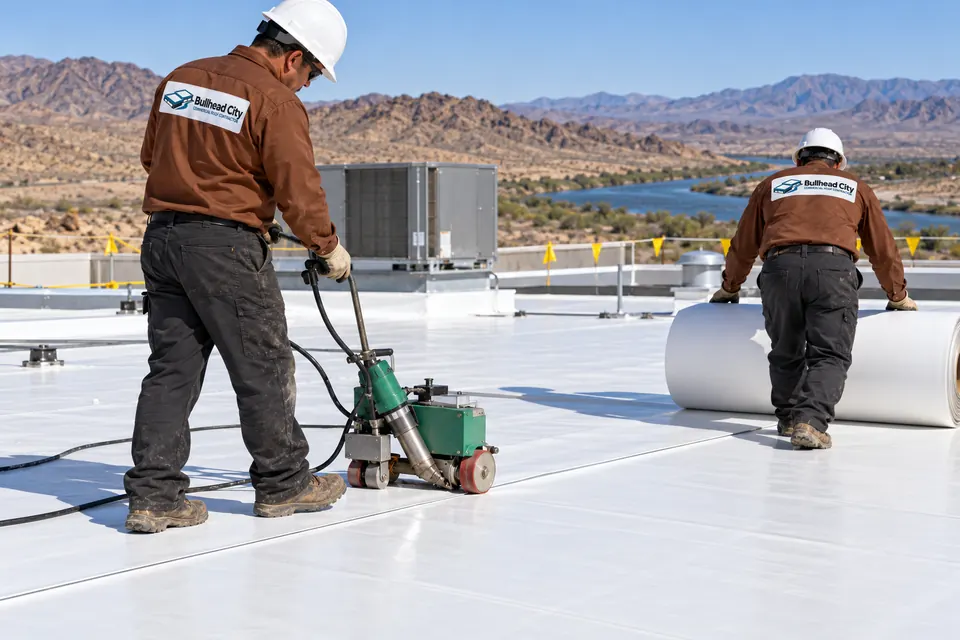
White welded TPO is the common choice for strip retail, with tapered insulation toward the rear drains.
TPO roofing details
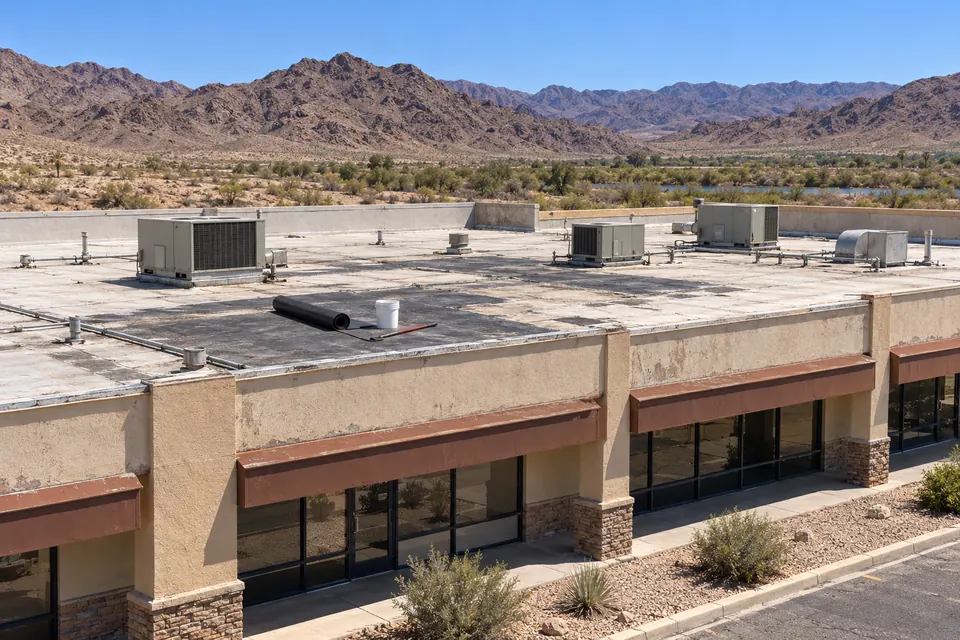
As a commercial roofing contractor in Fort Mohave, we replace and repair retail and office roofs along SR 95 and confirm who governs each parcel before work starts.
Fort Mohave is unincorporated Mohave County, and parts of it lie on Fort Mojave Indian Reservation land. A parcel on reservation land falls under the Tribe's own building department, which has used its own adopted code since 1991. The rest go through Mohave County Development Services.
The community name and the reservation boundary are two different maps, so we check each address before scheduling. The county runs a building and permitting office in Bullhead City, which keeps county permits close to the job.
Strip retail along SR 95 shows roof trouble on sales floors, in stockrooms, and at storefronts. Each pair points to its cause above.
A brown patch over the register area shows up after a storm and spreads.
An open TPO lap or a punctured membrane near a rooftop unit lets water travel under the sheet before it drips.
Puddles inside the front door after a downpour point to the front parapet or canopy.
Overflowing scuppers or a clogged gutter at the front edge spill water back against the wall and canopy flashing.
Boxes along the rear wall get wet first because water collects at the low side.
Rear drains and scuppers packed with dust, so water backs up along the low edge of the roof.
Drips over your suite started after the tenant next door had equipment serviced.
Shared membrane punctured, or curb flashing disturbed, during another tenant's work on the roof.
A space that never cools down sits under the darkest, most worn part of the roof.
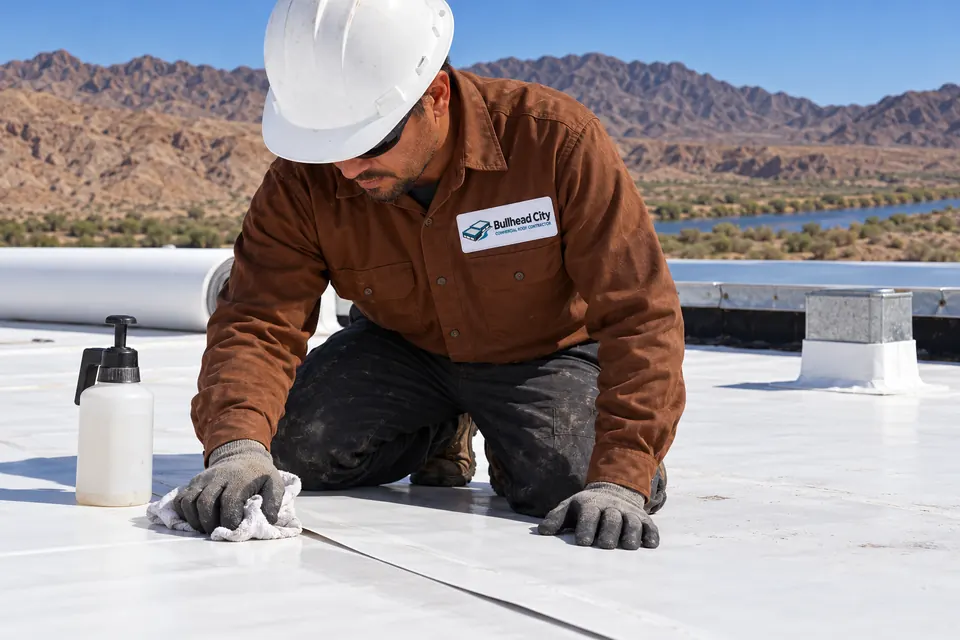
Chalked, weathered membrane soaking up sun. A new white TPO section reflects much of that heat.
For retail and office owners along SR 95, these are the changes that matter most.
Permits come from the county or the Tribe based on the parcel, checked before materials arrive.
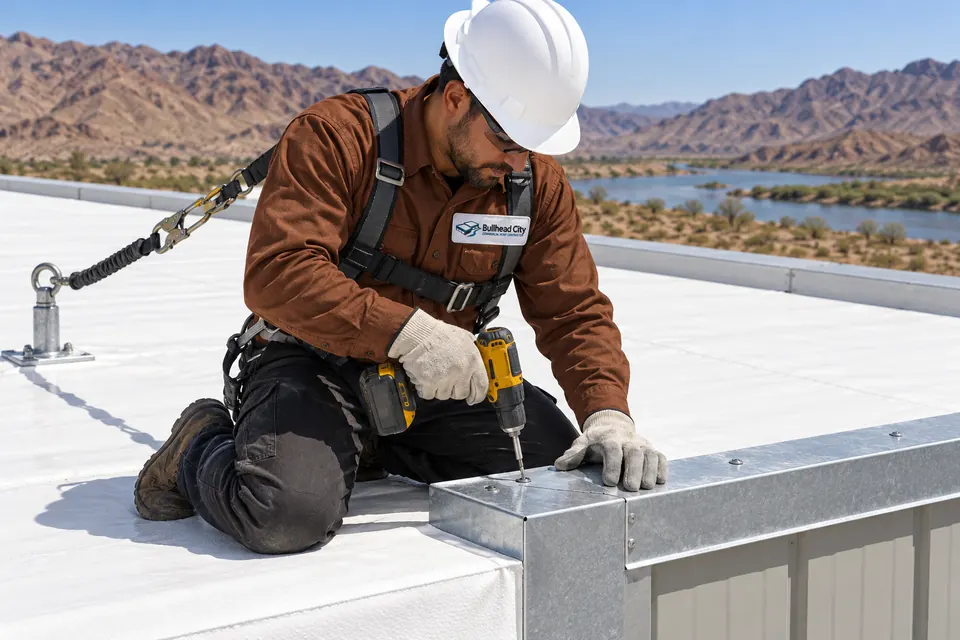
New scuppers, gutters, and edge metal carry monsoon rain away from storefronts and canopies.
One white TPO surface replaces mismatched patches, so every suite sits under the same reflective roof.
Years of tenant-by-tenant repairs give way to continuous welded membrane over the whole building.
Commercial roofs along SR 95 are mostly flat retail and office decks, with metal on shops and steel buildings.
White welded TPO is the common choice for strip retail, with tapered insulation toward the rear drains.
TPO roofing details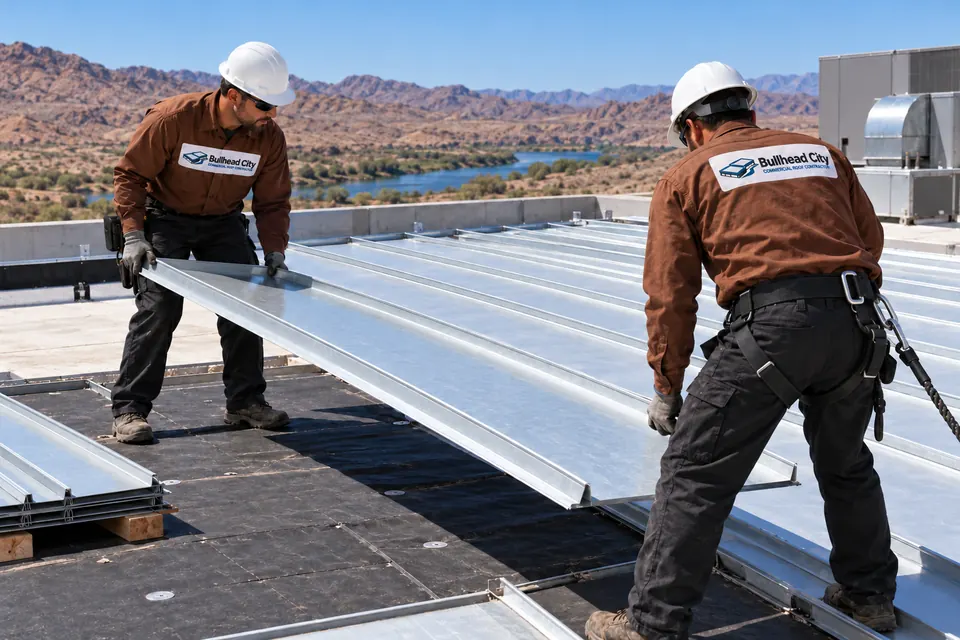
Shops and steel buildings shed monsoon rain under standing-seam or structural metal panels.
Metal roofing detailsCall and tell us whether it comes in at the storefront or the back wall. That tells us which roof edge to check first.
(623) 310-0188Four steps, starting with a roof inspection and a check of who issues the permit.
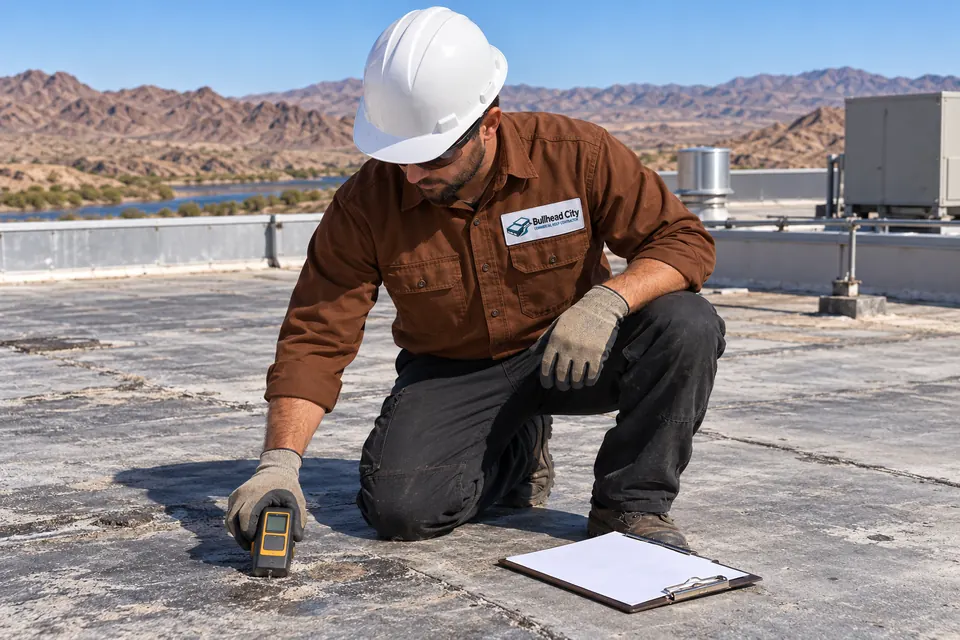
A roofer checks laps, curbs, drains, and the front and rear edges, takes moisture readings, and notes where each tenant's space sits below.
The parcel is checked against reservation land, then the roof permit goes to Mohave County or the Fort Mojave Building Department.
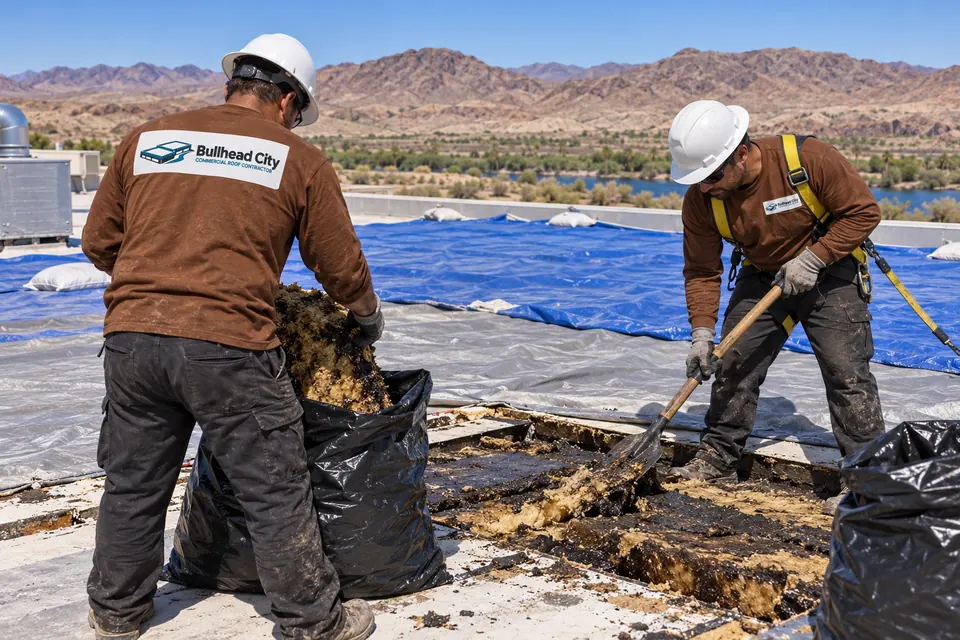
Roof sections over each suite are opened and sealed in turn, with staging kept away from storefronts and customer parking.
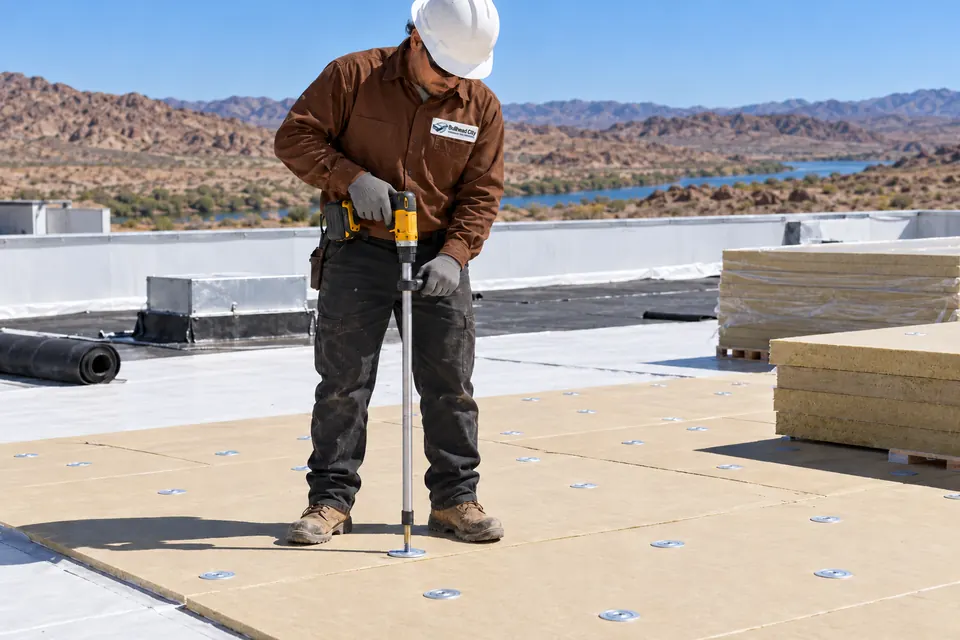
Scuppers, gutters, and edge metal go on at the front and back, then drains are cleared and the roof is walked.
Communities north and south of Fort Mohave, along SR 95 and the river.
The center of the service area, north on SR 95.
Office and medical roofs inside city limits.
Long-span warehouses just to the south.
Metal roofs on riverfront structures near I-40.
Answers about parcels, permits, and roofs over several tenants.
Some are. Parts of Fort Mohave lie on the Fort Mojave Indian Reservation, and its boundary does not follow the community name. Work on reservation land goes through the Tribe's building department, which has used its own adopted code since 1991. We check every parcel before scheduling.
Mohave County Development Services. Fort Mohave is unincorporated, so the county issues building permits, and its permit application includes a re-roof option for commercial work. The county runs a building and permitting office in Bullhead City besides its Kingman headquarters.
One roof, several leases. Work is planned suite by suite, with each tenant told which day the crew will be above them. Rooftop units serving each suite are shut down only during the closest work, and staging stays out of customer parking.
Front edges carry a lot of water. Canopies, parapets, and scuppers along the storefront collect monsoon rain fast, and a clogged scupper or loose canopy flashing sends it back toward the door. Clearing outlets and resealing the front edge solves most of these leaks.
It is usually the better plan. One continuous roof has fewer joints between old and new membrane, and drainage can be laid out for the whole building. When budgets call for phases, the tie-ins between old and new are planned at drain lines or walls.
Where the insulation is wet. A moisture meter, and sometimes a small core cut, shows which areas under the membrane hold water. Dry areas can stay under a recover layer, while wet ones come out. That map shapes the price more than roof size alone.
Mostly flat membrane on strip retail and offices, and metal panels on shops and steel buildings. The membrane roofs tend to leak at laps, curbs, and front edges. The metal roofs fail first at fasteners and panel laps.
It helps everyone. Tenants need to know when crews will be above their space, when rooftop units will be off, and where staging and dumpsters will sit. A short notice a few days ahead, and again the day before, keeps deliveries and customers clear of the work.
Send the roof size and the address, or call. We'll confirm the permit office for the parcel along with the roof work.
Leave a name and number, and a roofing contact will call you back about your building.
Or call (623) 310-0188 now