Commercial Roofing Questions For Bullhead City Buildings

Bullhead City sits on the Arizona bank of the Colorado River, directly across from Laughlin, Nevada, in a low-desert river valley known for intense summer heat.

Roofs Along The River

Retail strips along State Route 95, hospitality buildings, self-storage, medical offices, warehouses, and riverfront marinas carry low-slope or metal roofs that face punishing UV, long runs of extreme heat, and sudden summer storms.

(623) 310-0188

Bullhead City Commercial Roofing Questions By Topic

Commercial roofing questions about Bullhead City buildings, grouped by topic. Jump to one, or read straight through.

Roof Systems And Service Life

What does a TPO roofing contractor in Bullhead City actually install?

We install, repair, and replace TPO single-ply membranes on low-slope commercial roofs. TPO is usually white, so it reflects a large share of sunlight, which matters on buildings that bake through Bullhead City summers.

A typical TPO job includes:
  • Removing or overlaying the old roof after a moisture check of the deck and insulation
  • Mechanically fastening or adhering new insulation board and membrane
  • Hot-air welding every seam, then probing each weld
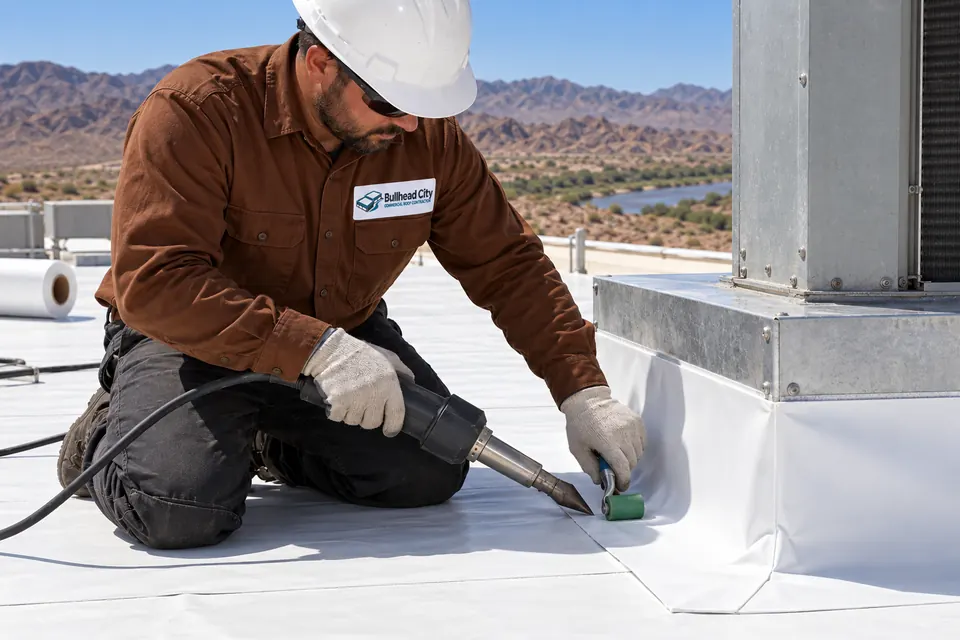
  • Flashing curbs, parapets, drains, and rooftop HVAC stands

Strip retail along State Route 95, office buildings, and storage facilities are common fits. See TPO roofing in Bullhead City.
Is EPDM a smart choice for a flat roof in desert heat?

EPDM can work well here, but color and detailing matter. Standard black EPDM absorbs heat, so many desert owners choose white-on-black EPDM or add a reflective coating.

EPDM is a flexible synthetic rubber that handles the swing between hot afternoons and cooler nights without cracking. Seams are taped or glued rather than welded, so seam prep is where quality shows.

We often recommend EPDM for:
  • Roofs with heavy foot traffic around equipment, protected by walkway pads
  • Buildings already on EPDM, where a tie-in repair is simpler than switching systems
  • Irregular roof shapes where large rubber sheets reduce the number of seams

More on EPDM flat roof installation.

What does an industrial roofing contractor do around Bullhead City and Mohave Valley?

Industrial roofing covers large-footprint buildings such as warehouses, distribution space, shops, and light manufacturing. These roofs are wide, often metal or single-ply, and loaded with exhaust fans, skylights, and conduit.

On industrial roofs we focus on:
  • Drainage across long spans, where small ponding areas grow over time
  • Penetrations from process equipment and exhaust stacks
  • Fall protection and safe access for crews and your maintenance staff
  • Sequencing work so production areas stay dry and running

More on industrial roofing for warehouses and shops.

Is a metal roof worth it for a commercial building in Bullhead City?

For many buildings, yes. Standing-seam and structural metal panels shed monsoon rain fast, resist wind uplift when fastened correctly, and pair well with reflective factory finishes.

Metal suits pre-engineered steel buildings, shops, warehouses, and newer retail with sloped roofs. Older metal roofs here often fail first at exposed fasteners, sealant joints, and panel laps rather than across the full panel.

Options we discuss with owners:
  • Fastener and seam restoration on a sound existing metal roof
  • Retrofit framing over an old low-slope roof to add pitch
  • Full panel replacement where corrosion or hail damage is widespread

More on commercial metal roofing options.

Which commercial roof system fits which type of building?

The right system depends on roof slope, foot traffic, rooftop equipment, and how long you plan to own the building. These pairings are a starting point, not a substitute for an on-roof inspection.

Building typeCommon fitWhy it works here
Strip retail and officesTPOReflective surface, welded seams, cost-effective on wide flat decks
Restaurants and hospitalityTPO or EPDMGood grease and equipment detailing with proper walkway pads
Warehouses and shopsMetal or TPOLarge spans, fast water shedding, fewer penetrations per square foot
Pre-engineered steel buildingsMetalMatches the structure and handles wind uplift with correct fastening
Older roofs with many add-onsEPDMFlexible sheets tie in around odd shapes and past repairs
Marinas and riverfront structuresMetalSheds water quickly and holds up to sun on exposed sites

How long do TPO, EPDM, and metal roofs last in Bullhead City?

With good installation and regular maintenance, TPO often lasts about 20 to 30 years, EPDM about 25 to 30 years, and metal 40 years or more. Extreme desert heat can shorten those ranges.

SystemTypical service lifeWhat shortens it here
TPOAbout 20 to 30 yearsThin membranes, poor seam welds, UV on exposed edges
EPDMAbout 25 to 30 yearsBlack membrane heat load, seam adhesive breakdown
Metal40 years or moreLoose fasteners, failed sealants, scratched coatings

Treat these as general ranges rather than promises. Membrane thickness, insulation, drainage, and how quickly small leaks get fixed all change the real number for your building.

Weather And Roof Condition

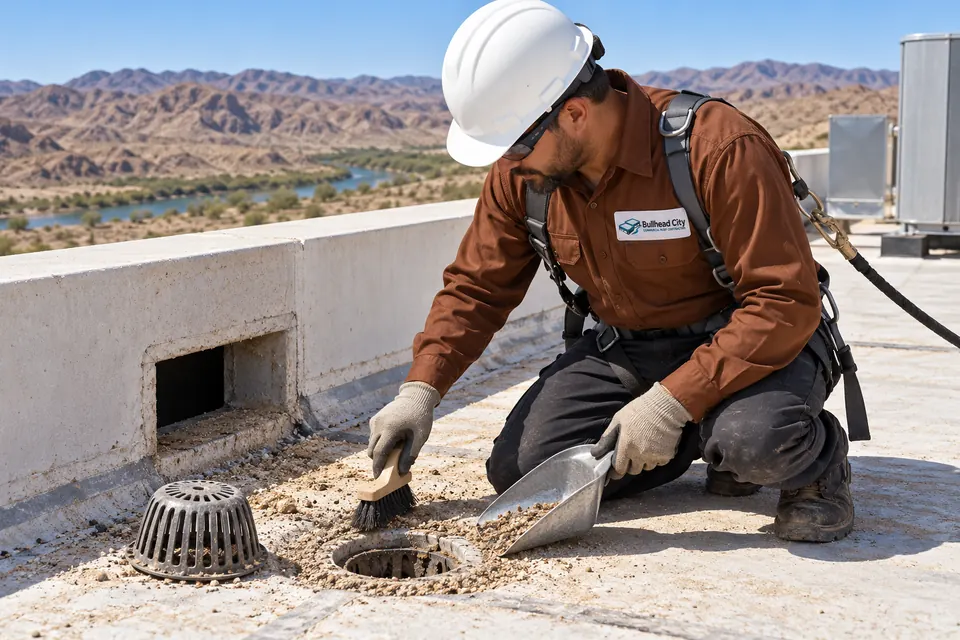
Roofer clearing windblown sand and grit from a roof drain beside an overflow scupper

How does Bullhead City's climate wear down a commercial roof?

Heat and UV do most of the damage, with summer storms adding sudden water and wind. Summer afternoons in this low-desert river valley are long and intense, and roof surfaces run far hotter than the air.

  • Heat and UV dry out sealants, chalk coatings, and age membranes faster than in milder climates.
  • Thermal cycling between hot days and cooler nights stresses seams, flashing, and fasteners.
  • Monsoon storms bring short, heavy rain, blowing dust, and strong gusts. Arizona's monsoon season officially runs June 15 through September 30, according to the National Weather Service.
  • Dust and debris clog drains and scuppers, so storm water backs up on flat decks.

The National Weather Service office in Las Vegas issues forecasts and warnings for the Bullhead City and Laughlin area, so watch its alerts before and after storms.

What should I check on my roof after a monsoon storm?

Check drains first, then look for standing water, lifted edges, and debris. Heavy rain plus blowing dust can clog outlets in minutes and leave water sitting on a flat roof.

  • Look inside for new ceiling stains, drips at light fixtures, or wet insulation smell.
  • Photograph damage and note the date for insurance records.
  • Keep staff off a wet or damaged roof surface.
  • Call for a professional inspection if you see open seams, loose metal, or bent flashing.

Temporary patches can stop active leaks, but a lasting repair needs a dry surface and proper materials.

How often should a commercial roof be inspected in Bullhead City?

Plan on at least two inspections a year, ideally in spring before summer heat and again in fall after monsoon season ends. Add a check after any severe storm.

A maintenance visit typically covers:
  • Clearing dust, leaves, and debris from drains, gutters, and scuppers
  • Resealing pitch pans, flashing terminations, and exposed fasteners
  • Patching punctures from foot traffic or dropped tools near equipment
  • Checking seams and edges for lifting after high winds
  • Noting ponding areas and photographing changes over time

Small fixes found early cost far less than interior damage, so keep a simple log of each visit and repair.

Should I repair my commercial roof or replace it?

Repair makes sense when damage is local and the deck and insulation underneath are dry. Replacement makes sense when wet insulation, failed seams, or leaks are spread across much of the roof.

Lean toward repairLean toward replacement
Leaks trace to a few flashings, curbs, or seamsLeaks keep returning in new spots after repairs
Membrane is still flexible and well adheredMembrane is brittle, shrinking, or pulling from edges
Infrared or core checks show little wet insulationA large share of the insulation holds water
Roof is well short of its expected service lifeRoof is near or past the end of its typical life

A middle path also exists. Restoration coatings or a recover layer can extend some roofs, but only after wet materials are removed and the existing system can still hold fasteners or adhesive.

Planning The Work

Roofer wrapping a rooftop HVAC curb with membrane flashing using a hot-air welder

Can you work on our roof without shutting the business down?

Usually, yes. Most commercial reroofing happens from the roof surface, so stores, offices, and warehouses can stay open with planning.

Ways we limit disruption:
  • Starting early in the day during summer, when heat is lower for crews and odors are easier to manage
  • Staging cranes, dumpsters, and material away from customer entries and loading docks
  • Dividing the roof into sections that are dried in before the end of each shift
  • Coordinating rooftop HVAC shutdowns and air-intake protection with your facility team
  • Watching monsoon forecasts so no section is left open ahead of a storm

Tell us about deliveries, peak hours, and sensitive areas such as server rooms or kitchens before work begins.

How do I get started on a commercial roof project?

Call us or request a free estimate to set up a commercial roof inspection. The inspection gives you a clear picture of the roof's condition before you decide between repair, restoration, or replacement.

During the inspection we check:
  1. The membrane or metal panels for cracks, blisters, shrinkage, and corrosion
  2. Seams, laps, and fasteners for separation or backout
  3. Flashing at parapets, curbs, skylights, and rooftop equipment
  4. Drains, scuppers, and gutters for clogs and ponding
  5. Signs of wet insulation or deck damage, using moisture testing where needed
  6. Interior ceilings and walls for active or past leaks

The findings are explained in plain language so you can plan the next step with confidence.

Permits, Taxes, And Utilities

Who issues roofing permits in Bullhead City and nearby communities?

It depends on whether the property is inside Bullhead City limits, in unincorporated Mohave County, or on Fort Mojave Indian Reservation land. We confirm the correct authority for each address before work starts.

LocationJurisdictionPermit authority
Bullhead CityIncorporated cityCity of Bullhead City Development Services
RivieraNeighborhood inside Bullhead City limitsCity of Bullhead City building permits
Fort MohaveUnincorporated Mohave County; parts lie on reservation landMohave County Development Services, or the Fort Mojave Building Department on tribal land
Mohave ValleyUnincorporated Mohave County; parts lie on reservation landMohave County Development Services, or the Fort Mojave Building Department on tribal land
Golden ShoresUnincorporated Mohave CountyMohave County Development Services
TopockUnincorporated Mohave CountyMohave County Development Services

Bullhead City adopted the 2018 International Code Council construction codes with local amendments in April 2024. Mohave County's building permit application includes a re-roof option for both commercial and residential work, and the county runs a building and permitting office in Bullhead City as well as its Kingman headquarters.

Do roofing projects on Fort Mojave tribal land follow different rules?

Yes. Property within the Fort Mojave Indian Reservation falls under the Tribe's own building department rather than Mohave County. The Tribe has used its own adopted building code since 1991.

The reservation spans parts of Arizona, California, and Nevada along the Colorado River, and its boundaries do not line up neatly with community names. Before scheduling work in Fort Mohave or Mohave Valley, we verify whether the parcel is tribal land and contact the right office.

Can a new commercial roof qualify for the Section 179 deduction?

Often, yes. Roofs placed on existing nonresidential buildings can count as qualified real property under Section 179, so a business may be able to expense the cost in the year the roof goes into service instead of depreciating it over decades.

Key points to raise with your tax advisor:
  • Annual cap: for tax years beginning in 2026, the maximum Section 179 deduction is $2,560,000, per IRS Publication 946.
  • Building type: the roof must be on nonresidential real property; residential rental buildings do not qualify.
  • Existing building: the roof must be an improvement placed in service after the building itself was first placed in service.
  • Phase-outs and income limits can reduce the deduction.

Tax treatment depends on your full financial picture. Consult a CPA before you count on any deduction.

Which electric utility serves my building, and are there rebates for cool roofs?

Most of Bullhead City is served by Mohave Electric Cooperative, with UniSource Energy Services covering a smaller area, according to the city's outside agency list. Reservation properties may be served by Aha Macav Power Service, the Tribe's own electric utility.

  • Mohave Electric Cooperative serves most areas inside the city.
  • UniSource Energy Services provides electric service in parts of Mohave County, including the Punto De Vista area of Bullhead City.
  • Aha Macav Power Service is the tribally owned utility for the Fort Mojave Indian Reservation.

Confirm your provider on a recent bill, especially in Golden Shores and Topock. Utility efficiency programs change often and may not cover roofing at all, so we never promise a rebate.

When a program does apply, it commonly requires a product rated by the Cool Roof Rating Council, and we can help you choose a listed membrane or coating.

Service Areas

What areas do you serve?

We serve commercial and industrial properties in Bullhead City and nearby Colorado River communities:

If your building sits just outside these communities, ask anyway. We confirm the permitting authority and utility for each address before scheduling work.

Still Have A Roof Question?

Call and ask it, or send the roof size and the problem for a free estimate.

Call (623) 310-0188